
Asphalt overlays
Driveway Resurfacing in Noblesville, IN
A fresh surface for a driveway whose foundation is still doing its job.
- Free on-site estimates
- Base depth and asphalt thickness written into every quote
- Right-of-way and 811 locate steps planned before digging
When an Overlay Makes Sense
Driveway resurfacing lays a new course of hot-mix asphalt over the existing surface instead of tearing it out. It suits a driveway that is rough, faded and covered in fine cracks but still firm underfoot, with no ruts or soft spots. Lots of Noblesville subdivision driveways built during the 2000s growth spurt are in exactly that condition now. An overlay gives them a new wearing surface for considerably less than full replacement; HomeGuide puts the savings at roughly 20 to 30 percent.
The base has to pass first
An overlay inherits whatever is underneath. If the existing driveway has alligator cracking, sunken areas or edges that have broken away, those failures reflect up through new asphalt within a season or two. So before recommending resurfacing we walk the surface, push on edges, and probe the worst areas. Isolated soft spots can be cut out and rebuilt before the overlay. Widespread failure means replacement is the honest answer.
Getting the heights right
New asphalt adds height, usually 1.5 to 2 inches. That matters at the garage slab, the sidewalk and the street apron, where a new lip can trip people or trap water. We mill or grind a strip at those transitions so the new surface meets them flush, and keep the overlay thickness from building up against the garage door.
Preparation steps
- Cleaning the surface and edges of dirt, grass and loose material
- Cutting out and rebuilding failed patches
- Filling larger cracks so they do not telegraph through quickly
- Milling transitions at the garage, walks and apron
- Spraying a tack coat so the new layer bonds to the old
- Placing and rolling the new course
What an overlay will not fix
Resurfacing does not cure a drainage problem. If water stands in the same spot every spring, we look at regrading in the same visit. It also cannot stop reflective cracking entirely over a heavily cracked surface; fine cracks may reappear over the years. We tell you what to expect before you choose.
Timing
Overlays are thin, and thin lifts lose heat fast. That makes them more sensitive to cold weather than full-depth paving, so we schedule resurfacing from late spring through early fall.
What This Covers
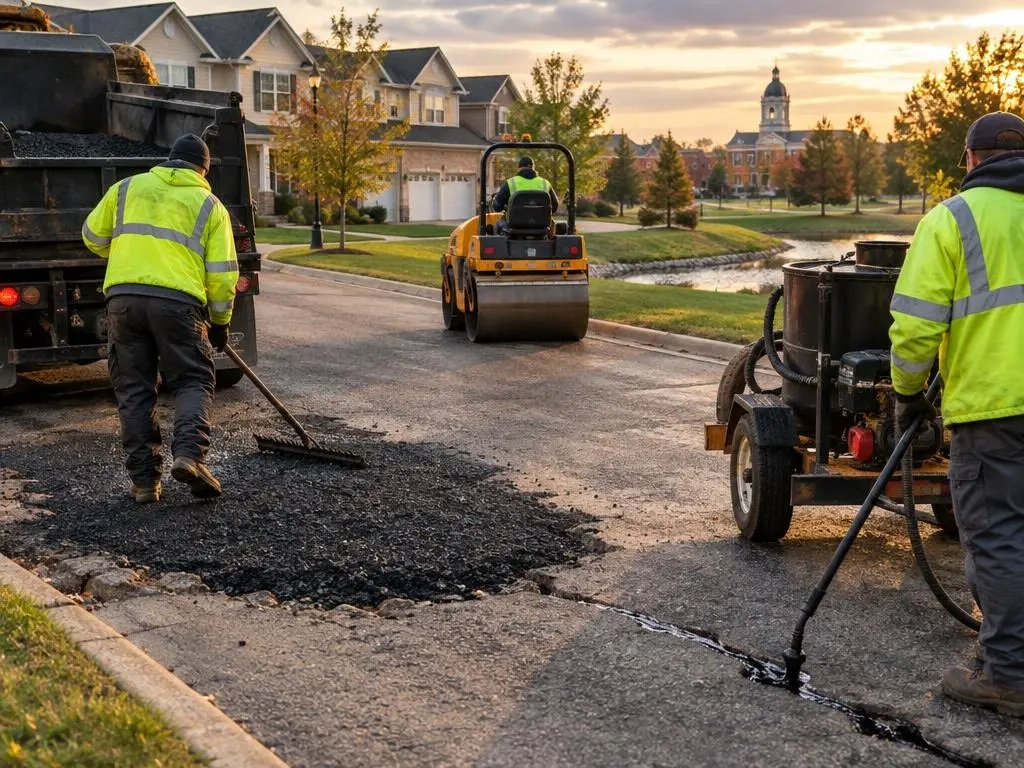
Resurfacing is mostly preparation, followed by a single paving pass.
Base assessment
Probing and walking the surface to confirm an overlay will hold.
Spot repairs
Cutting out failed areas and rebuilding them before the overlay goes on.
Transition milling
Grinding at the garage, walks and apron so new asphalt meets them flush.
Tack coat and overlay
Bonding coat followed by a new hot-mix wearing course, rolled smooth.
Typical Resurfacing Costs
| Item | Published range |
|---|---|
| Driveway resurfacing (HomeGuide driveway guide) | $3 to $7 per sq ft |
| Asphalt overlay (HomeGuide repair guide) | $1 to $3 per sq ft |
| Savings vs. full replacement (HomeGuide) | About 20% to 30% |
| Saw-cut patch before overlay (HomeGuide) | $4 to $12 per sq ft |
National ranges from HomeGuide's two cost guides, which price overlays differently depending on scope and prep. Milling, patching and drainage corrections are priced separately. Your written estimate is the price.
How It Works
1. Check the base
We confirm the driveway is a candidate for an overlay, or tell you it is not.
2. Repair and mill
Failed spots rebuilt and transitions ground down.
3. Tack and pave
Bonding coat, then the new asphalt course placed and rolled.
4. Cure
A few days off the surface, and sealing held off for several months.
Driveway Resurfacing Questions
How do I know if my driveway can be resurfaced instead of replaced?
If it is firm, drains reasonably and mostly has surface wear and fine cracks, it is a candidate. Alligator cracking over large areas, ruts, potholes that keep coming back or soft spots mean the base has failed and replacement is the better spend.
How thick is an overlay?
Usually 1.5 to 2 inches of compacted asphalt. Thicker overlays are possible but raise the surface more at the garage and walks, which is why transition milling is part of the job.
Will cracks come back after resurfacing?
Some can over time. Cracks in the old surface can reflect up through the new layer. Filling the larger cracks and rebuilding failed spots first slows that down.
Is resurfacing worth it if I plan to sell?
Often yes. A fresh, black driveway changes how a house looks from the street, and an overlay costs less than replacement. If the base is bad, though, buyers' inspectors may notice the cracks returning.
Driveway Resurfacing Service Areas
- Asphalt Paving in Noblesville, IN
- Asphalt Paving in Fishers, IN
- Asphalt Paving in Carmel, IN
- Asphalt Paving in Westfield, IN
- Asphalt Paving in Cicero, IN
- Asphalt Paving in Arcadia, IN
- Asphalt Paving in Sheridan, IN
- Asphalt Paving in Atlanta, IN
- Asphalt Paving in Anderson, IN
- Asphalt Paving in Pendleton, IN
- Asphalt Paving in Lapel, IN
- Asphalt Paving in Ingalls, IN
- Asphalt Paving in Fortville, IN
- Asphalt Paving in McCordsville, IN
- Asphalt Paving in Zionsville, IN
- Asphalt Paving in Tipton, IN
- Asphalt Paving in Elwood, IN
- Asphalt Paving in Lawrence, IN
- Asphalt Paving in Chesterfield, IN
- Asphalt Paving in Greenfield, IN
- Asphalt Paving in Alexandria, IN
- Asphalt Paving in Frankton, IN
Get a Driveway Resurfacing Estimate
Find out whether your driveway is a candidate for resurfacing. Free estimates.